

The Bottleneck Wasn't the Math
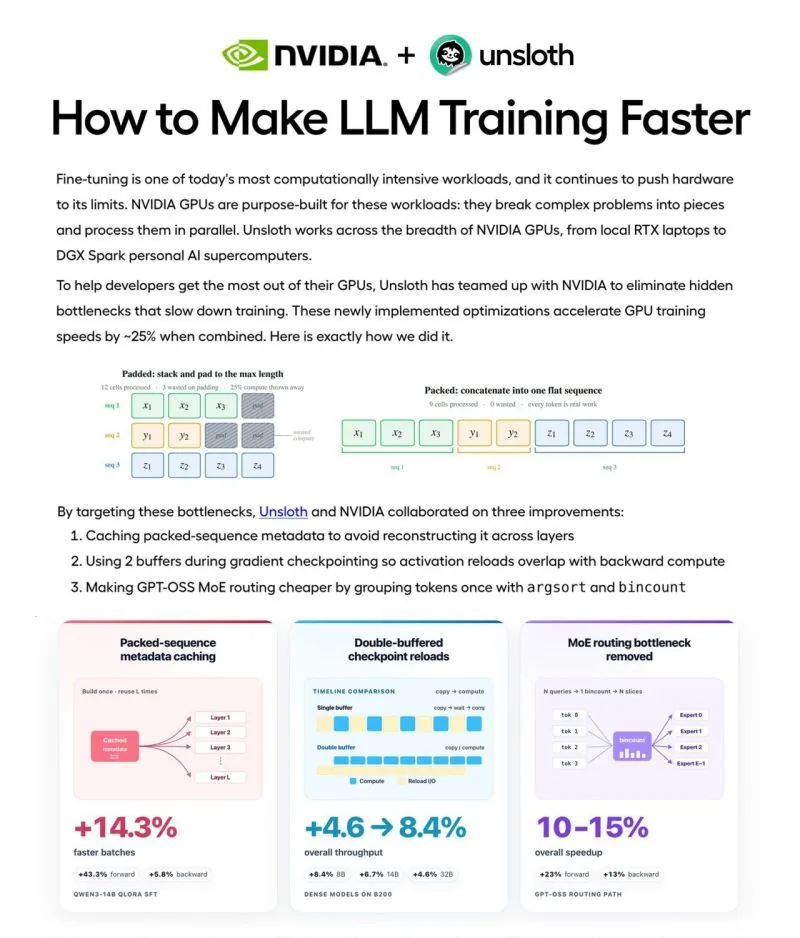
The Unsloth AI team shipped a collaboration with NVIDIA that fixes three things most training stacks were quietly bleeding time on. No new model. No accuracy hit. No hyperparameter tuning. Just three targeted fixes to the glue code between GPU kernels — the parts that were rebuilding metadata, serializing copies, and querying the runtime once per expert.
Here's what each fix is actually doing under the hood.
Fix 1 — Cached Packed-Sequence Metadata
Every transformer layer was rebuilding the same boundary information — cu_seqlens, max_seqlen, mask structure — and forcing a GPU–CPU sync per layer. The data existed. It was just being thrown away and reconstructed identically on the next layer.
The Fix
Build it once per batch. Reuse it L times (once per layer). The sync that was happening on every layer now happens once.
The Result
+43.3% forward, +5.8% backward, +14.3% per batch on Qwen3-14B QLoRA SFT. The largest single gain of the three improvements — because it compounds across every layer in the model.
Fix 2 — Double-Buffered Checkpoint Reloads
Gradient checkpointing trades memory for compute by discarding activations during the forward pass and recomputing them during the backward pass. The problem: activation reloads from pinned CPU memory were serializing on a single buffer — copy, wait, compute, next copy. The GPU was sitting idle during every copy.
The Fix
Two buffers run copy + compute in parallel. While one buffer is being computed on by the GPU, the next activation is already being loaded into the second buffer from CPU memory.
The Result
+8.4% on 8B, +6.7% on 14B, +4.6% on 32B dense models on B200. Memory overhead stays under 0.5 GB — negligible compared to the model itself.
Fix 3 — Argsort + Bincount MoE Routing
Mixture-of-Experts models route each token to a subset of experts. The naive implementation used torch.where(router_indices == expert_idx) in a loop — one iteration per expert, each triggering a CPU–GPU sync to query how many tokens were assigned to that expert.
The Fix
One stable sort (argsort) groups all token–expert assignments. One bincount counts tokens per expert. Offsets are computed once and reused everywhere. The O(num_experts) sync loop collapses into two kernel calls.
The Result
+23% forward, +13% backward on the GPT-OSS MoE routing path. A 10–15% overall speedup on models using sparse expert routing.
The Pattern Across All Three
The math kernels — attention, matrix multiply, activation functions — were already fast. The bottleneck in each case was the coordination layer: rebuilding metadata the runtime already computed, serializing memory transfers that could overlap, polling the device once per expert when a single sort would do.
Group once. Cache once. Overlap the rest.
This is the kind of optimization that's invisible in benchmarks that test individual kernels but shows up immediately in end-to-end training throughput. The kernel is fast. The glue code around the kernel is the bottleneck.
Why This Matters for Practitioners
Auto-enabled on RTX laptops, B200 data center GPUs, and DGX Spark. Apache 2.0. Zero accuracy loss. If you train models, this is one pip install --upgrade unsloth away.
The broader lesson: before reaching for a larger GPU or a different architecture, audit the coordination overhead. Packed-sequence reconstruction, serialized copies, per-expert runtime queries — these are the kinds of inefficiencies that don't show up in FLOPs calculations but compound across every batch of every epoch of every training run.